Question Mark
in Ismay
Bob Levitt
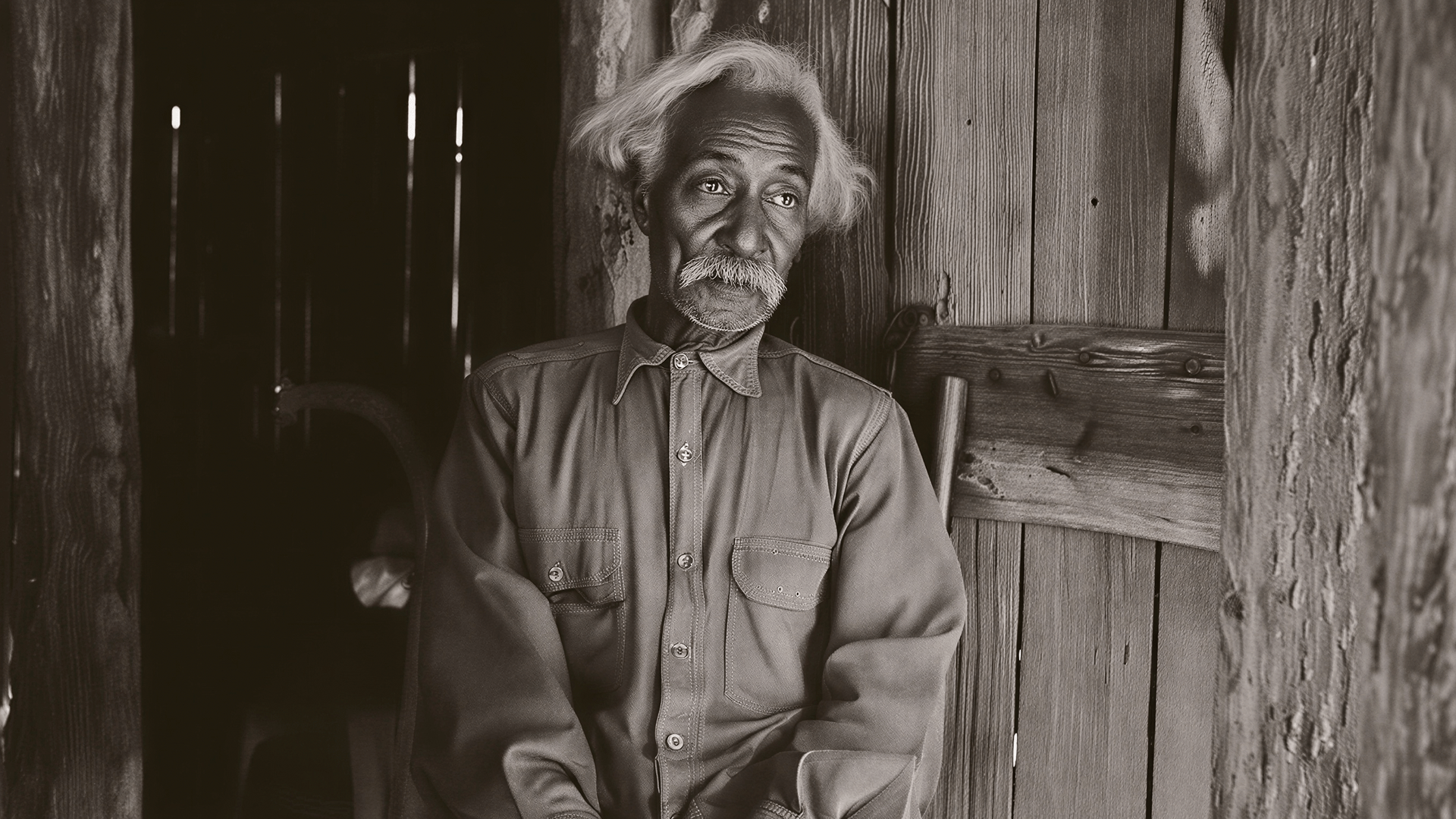
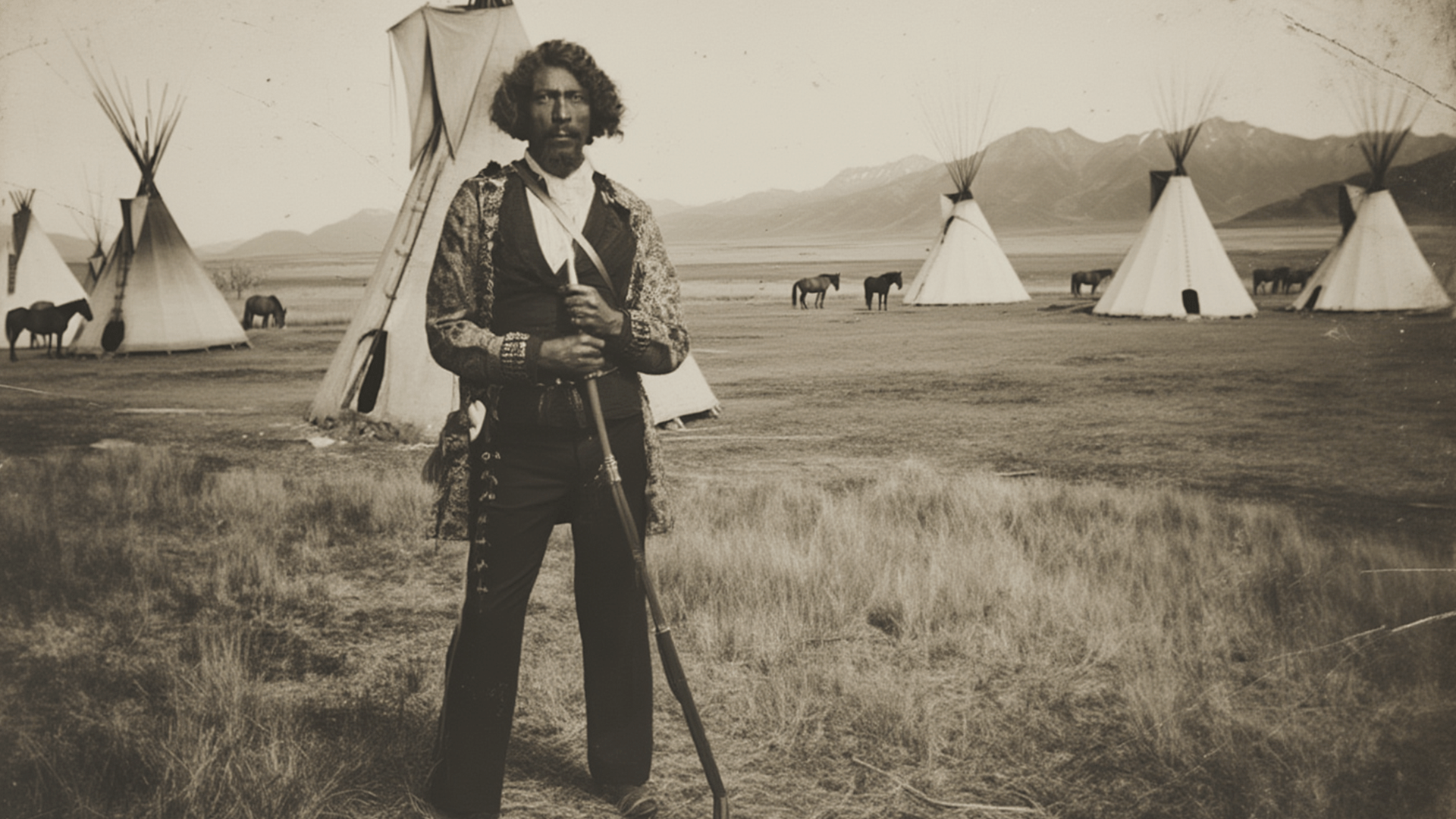
The first photograph lies flat on the table, the one with the false front in Ismay and the hand-painted sign that reads B. LEVITT, PROPRIETOR. Folks like to argue over that picture. Some say it shows a white man on the boardwalk. Others swear the man’s skin carries a shadow that does not fit neatly on census lines.
I am one of those others.
My name is Dr. Imani Taylor, and I have spent a decade listening to the West talk back through brittle paper and ghost handwriting. When I first saw the Levitt photograph in a Montana archive box, the clerk at the desk said, “Oh, that one. Some local saloon keeper. White fella, far as we know.” I nodded, then asked to see the back. Someone long gone had written, in looping ink,“Bob Levitt, good with cards, mixed?” That question mark hooked into me and never let go.
So I keep coming back to this day in Ismay, one afternoon near the end of the nineteenth century, retold by people who never sat in the same room, all sure they are right about what color Bob Levitt was and what that meant.
They talk about the same hours. They do not tell the same story.
❦
The first voice is Bob’s, because he paid for the sign and swept his own porch. I picture him a slim man, hair oiled and parted, eyes that keep a ledger of everything that passes by. His skin is the color of pecan shells, brown but smooth, something that unsettles people who need the world sorted.
On this day, clouds ride low over the Tongue. Bob steps onto the porch with a broom and squints at the sky.
“Rain if we are lucky,” he mutters. “Hail if we are not. Same thing folks say about me.”
A wagon rattles past. The driver lifts two fingers. Bob nods back and starts to sweep. He works with the same rhythm he once used on a Mississippi dock, when his name was not on a sign, and his skin was never allowed to be anything but Black. He still hears the word from the old ledger:“mulatto,” chewed like gristle by a clerk who never looked him in the eye.
Montana feels different. The Civil War is over, the railroad whistles along the valley, and men here claim to care more about how quickly you can pour whiskey than how your grandmother looked. The claim wears thin whenever someone Black tries to buy land, whenever a white man decides to test a rumor.
Boots crunch on gravel. A rider dismounts, ties his horse to the rail, and comes up the steps. The man is dark-skinned, broad-shouldered, hat tipped low.
“Afternoon,” the stranger says. “This your place?”
Bob leans on the broom. “If the bank note says so, then yes. You thirsty, or just curious?”
“Both.” The man grins. “Name’s Nat. Nat Love.”
Stories have run ahead of that name. Bob has heard of a Black cowboy who rode from Tennessee to the Dakotas, who won contests in Deadwood. Some call him Deadwood Dick.
Bob opens the door. “Then come in, Mr. Love. We can trade curiosities for the price of a drink.”
❦
Nat tells it differently years later, when he is working as a Pullman porter, and his listeners lean in to escape the boredom of the rails.
“I stepped into a little saloon up in Montana,” he says, “and the air smelled of pine soap and cigar smoke. There was a big mirror behind the bar, and in it I saw a fellow moving like home folks. Too smooth to be green, too watchful to be careless.”
The younger porter raises an eyebrow. “You mean colored?”
“I mean,” Nat answers, “he moved like a man who had been studied for trouble since he could walk. His hair was straight and his nose narrow, but his eyes counted doors and hands like mine.”
In Nat’s memory, he tips his hat, and the bartender does the same.
“Afternoon,” Nat says. “I am seeking a drink that will not kill me and a rumor that might pay.”
“We sell both,” the bartender replies. “Whiskey is twenty-five cents. Rumors cost whatever they make you remember.”
Nat laughs and takes a seat. “You Levitt?”
“So the sign says.” Bob pours two glasses. “What folks say depends who is asking.”
“I am asking,” Nat says, “as one colored man to another, if I am not mistaken.”
Maybe Nat really said it. Maybe he only thought it. Either way, in his telling, Bob pauses, then smiles without showing teeth.
“Is that what you see?” Bob asks.
“I see a man who did not get that shade from Scandinavia,” Nat says. “Out here they call me Mexican sometimes, so they can sit easy at the card table. Colored is what my mama called me, and that is what I call myself when I pray.”
Bob polishes an invisible spot on the bar. “Names out here get written on licenses and land deeds. White men like to squint and decide what you are before they decide what you can own.”
They drink, talk cattle and weather, and they do not say every word hanging between them. Some conversations occur in side glances and in the quiet relief of seeing someone whose presence says,you are not the only one out here carrying more than white folks’ stories.
❦
The third voice is white and dry as old paper. It belongs to Mr. Keane, the town photographer, who writes in his ledger that same afternoon.
“Mr. B. Levitt of Ismay called for a portrait of his establishment,” he notes. “Proprietor is of darker complexion, perhaps Southern. Not Negro, I judge. Could be Spanish, Creole, or some such.”
Years later, when a county historian visits, Keane phrases it another way.
“The saloon keeper?” he says. “Yes, I recall him. A civil sort. Not one of the coloreds, no. We had those, with the railroad and the section gangs. They kept mostly to their own streets. Levitt did not. He sat on committees, paid his license, attended church socials. My wife said he had an olive look. That is all we meant.”
“Would a Black man have been allowed to own a saloon on the main street?” the historian asks.
Keane shrugs. “Formal rules were one thing. What men let pass was another. If a fellow kept order and paid his fees, he got more leeway than back East. Still.” He lifts a finger. “No one would accept a Negro as fully white. Levitt, now, he occupied a sort of comfortable middle. Respectable, but watched.”
In his account, the afternoon is simple. He carries his tripod and glass plate, and sets them in the street. Bob stands on the boardwalk, broom in hand. Nat, impatient, leans a step back in the doorway where the shadows begin.
“Look straight ahead,” Keane calls. “Hold still.”
The shutter blinks. The image catches sunlight, dust, and wood grain, faces collapsed into gray. Keane cares about focus and payment. He does not care what Levitt’s grandparents looked like.
❦
Back in the archive, I turn the print under the lamp. Time has reduced skin to a narrow scale of gray that lies to everyone equally. Bob’s face is a thumbprint smudge between sun and shade. Nat is barely there. The sign is clear. The census is less so.
“People come to this photograph already asking, ‘Was he Black?’” I tell Rose, the Cheyenne undergrad who helps with scanning. “So they stare at shadows on his cheekbones as if silver nitrate took an oath to tell the truth.”
Rose squints. “Out home, we tell stories of men who left and came back with new names,” she says. “Some were Black men who married in. Their grandchildren were always talked about. Not white, not fully us, carrying gossip on both sides. Maybe this Levitt was like that.”
“Maybe.” I lay out a 1900 census sheet. There is aRobert Levett in a nearby county, born in Mississippi, parents from the South, occupation saloon keeper. In the race column, the clerk wrote
W. On the same page, he marked a Jackson family
B, and an engineer from Texas
M for mulatto.
“He saw color when he wanted to,” I say. “So if he wrote this Levett as white, he either did not see him as Black, or chose not to.”
“You think Levitt told him to write white?” Rose asks.
“I think Levitt knew the cost of the other boxes,” I answer. “In Mississippi, colored meant no vote, no jury, almost no safety. Out here, the lines were thinner, but they were still there. Scholars like Quintard Taylor show how Black westerners walked between new chances and old racism. Some got work and land. Some were pushed back the moment white neighbors felt crowded. So men learned to negotiate. Some said Mexican, some said Spanish. Some said as little as possible.”
Rose taps the photograph. “So was he Black?”
“In that century,” I say, “being Black meant more than ancestry. It meant where the law placed you, where white people were willing to let you stand. Black drovers worked right alongside white ones. On paper they might appear as white, Indian, or not appear at all. The cattle cared nothing. County officials did.”
She smiles wryly. “Same old story. Power holds the pencil.”
“Exactly.”
❦
If you ask Bob in the version I carry, late at night, wiping glasses, he does not recite fractions of blood. He talks about his mother, who hummed river songs in a tongue older than English, and his white father, a clerk who freed him before the war and left him a name. He talks about seeing Black soldiers in blue march through New Orleans and deciding he would go where uniforms did not tell his whole story.
“When I headed west,” this Bob says, “I told myself I would answer only to the name on my sign. Folks out here called me all sorts of things. ‘Darky’ if they were drunk. ‘Spaniard’ if they were polite and puzzled. ‘Mister Levitt’ if they owed me money.”
One night, a drifter asks him straight, “What are you?”
“I am the man who owns the roof over your head,” Bob answers. “That enough?”
It is bravado. It notes that sometimes he wakes before dawn and wonders which side of the color line will claim him when things turn bad.
“Say Black,” he thinks, “and some white men decide I do not deserve this business. Say white, and every colored man who walks through that door will know I have chosen distance over kin.”
Most days, he says nothing. He lets customers argue in low voices about his complexion, the way they argue about the weather. He keeps the whiskey flowing and the cards moving, and he stays alive.
❦
Years later, a museum board calls me in to write a label for the photograph. They want something short and useful for marketing.
“How about‘Local saloon owner, identity unknown’,” one trustee proposes.
“That sounds dull,” another says. “What if we say‘B race proprietor’? It would highlight diversity.”
They turn to me.
“Tell us, Dr. Taylor,” the chairwoman says. “Was he Black? We would like to feature Black entrepreneurship in our exhibit.”
“I can tell you,” I say, “that he was likely born in Mississippi. That at least one note from the period calls him‘mixed’, with a question mark. The census man wrote him down as white. That Black men worked cattle and ran businesses in this region, even when newspapers ignored them. What I cannot tell you is what he called himself when the census taker rode away.”
The chairwoman frowns. “So what do we put on the label?”
“Write this,” I say. “Robert ‘Bob’ Levitt, proprietor of a saloon in Ismay, Montana, around 1895. Born in Mississippi, he was described by some contemporaries as mixed race while official records listed him as white. His life shows how racial identity in the West was negotiated in practice.”
“That is a lot of words,” a trustee mutters.
“So is ‘territorial legislature,’” I reply.
Rose, sitting in the back, hides a smile.
❦
At the end of another archive day, I step outside. The Montana sky is wide enough to swallow all our arguments about pigment. Somewhere under the asphalt lies the trace of Ismay’s old main street, the boards Bob swept, the doorway where Nat leaned, the spot where Keane set his tripod.
I think about their voices, how each holds tight to its own answer.
Nat, needing kin in a dangerous country, insists, “I know my own when I see them,” and folds Bob into a Black trail he can follow across miles.
Keane, needing order, insists, “He was not Negro,” and folds Bob into a whiteness wide enough to keep town politics simple.
The census man, needing a single letter for each line, writes W and rides on, leaving his choice to become fact in future eyes.
And Bob himself, somewhere between them all, keeps the broom moving and the whiskey poured, unwilling or unable to satisfy anyone’s curiosity without risking everything he has built.
Race in the West was not a fixed border so much as a dust cloud kicked up by hooves, swirling thicker around some people than others, hard to breathe if you were caught in it, easy to ignore if the wind was at your back.
As I walk to my car, I decide to give Bob one more line.
“Call me what you will,” I imagine him saying as he leans on his bar. “When the blizzard came, I let every hand in town warm up by my stove. When ranchers needed credit, I carried their tabs. I paid my license, and I paid my help. If that is not a life worth remembering, maybe the problem is not my color, but your questions.”
In another town, on another night, Nat Love hears that and raises an invisible glass in my mind.
“To Bob Levitt,” he says. “Whatever color they say he was.”
The toast crosses years, papers, and pixels. It lands here, where I sit at a desk, writing his name into a history that nearly forgot it. I do not erase the question mark on the back of the photograph.
I leave it where it belongs, a small curved sign reminding all of us that the West was full of lives that refused to stay inside anyone’s neat lines.
End Notes
1. Quintard Taylor, In Search of the Racial Frontier: African Americans in the American West, 1528–1990 (New York: W. W. Norton, 1998), documents Black cowboys, entrepreneurs, and communities across the West and the fluid yet policed color line in frontier towns.
2. Quintard Taylor, “African American Men in the American West, 1528–1990,” culturahistorica.org
3. Quintard Taylor, “African Americans on Western Cattle Drives, 1868–1885,” BlackPast.org
4. D. L. Kersting, “Exploring the Experiences of Minority Cowboys During the Open Range Era,”
5. NPS research report, “African-American Heritage Places in Helena, Montana,” National Park Service report
More Chapters

Choose your Trail